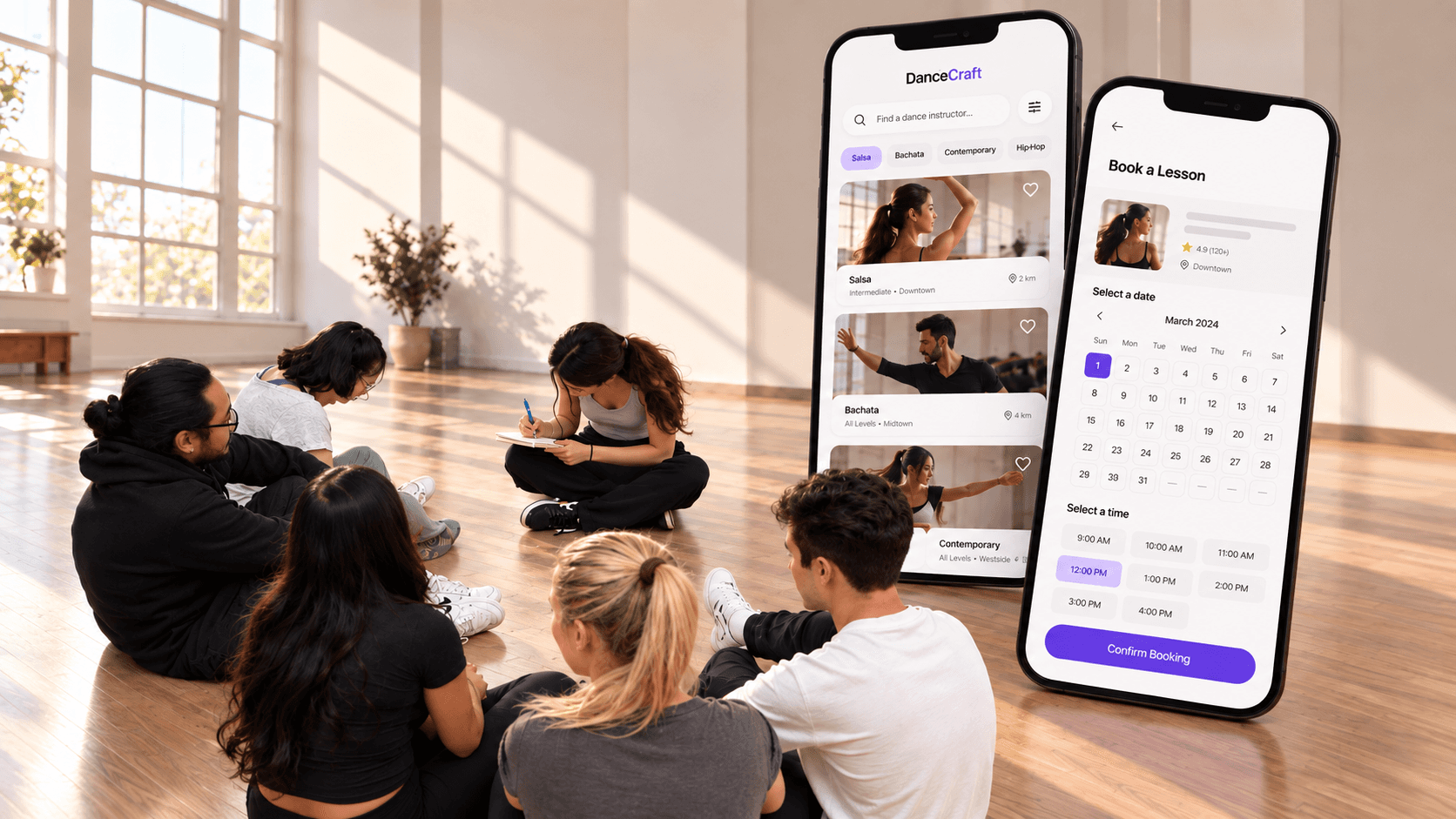
DanceCraft is available to download on iPhone and Android today.
ux Research · Usability testing · Mobile Application (IOS and ANDROID compatible)
Year
2026
Role
End-to-end Product Designer (research, strategy, UX/UI)
Timeline
Sep 2026, On-going
Team
DanceCraft Company
METHODS & Tools
Workflow Walkthrough, User Interviews, Affinity Mapping, Empathy Mapping, Storyboarding, Personas, Journey Mapping, Competitive Audit, MoSCoW Prioritization, Figma, FigJam, Claude Design, Framer, React Native, Usability Testing (SEQ, SUS), Accessibility Testing
Project Link
Overview
Booking a private dance lesson today happens across Instagram, WhatsApp, calendars and e-transfers. I interviewed students and instructors, mapped the current booking workflow, and defined a product that brings discovery, trust, availability, booking and payment into one dance-specific experience.

DESIGN APPROACH
This project followed Konrad’s seven steps of Design Thinking: empathize, define, ideate, prototype, test, implement, and learn. Each stage translated research evidence into a more grounded product decision.
Research · Empathize · Define · Ideate · Prototype · Test & Iterate · Implement
Problem
Private lessons are fragmented across disconnected tools
Independent instructors often rely on Instagram, WhatsApp, personal calendars, and e-transfers to advertise and manage private lessons. Students move between those same systems to compare instructors, ask for basic information, negotiate availability, and complete payment.
Private dance students and independent instructors need a more connected way to discover, evaluate, book, and manage private lessons because the current experience is fragmented across social media, messaging, calendars, and payment tools.
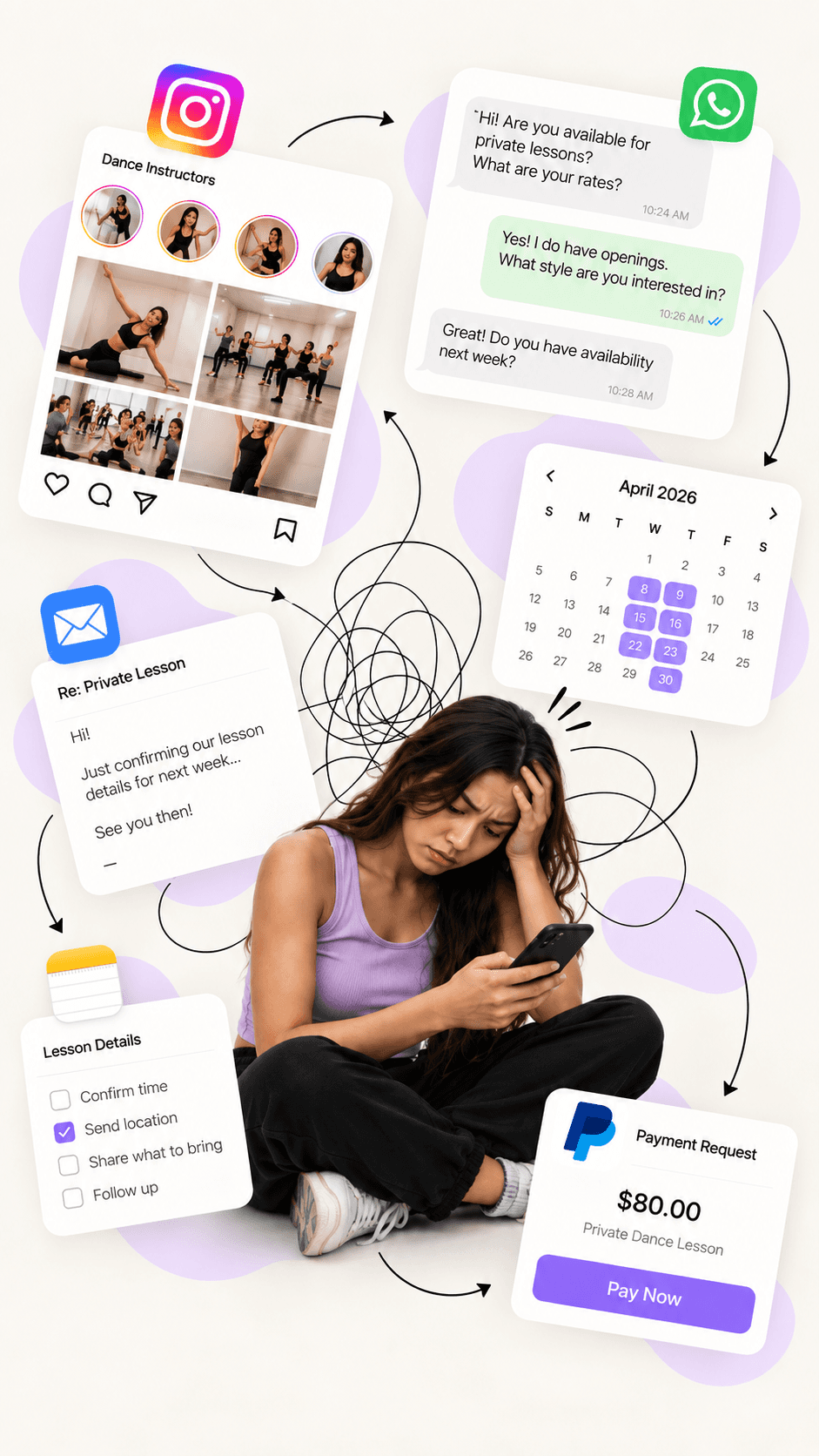
Design Problem
How might we connect the entire private-dance lesson journey so students can book with confidence and instructors can
gain visibility while spending less time on admin?
01 RESEARCH
Private booking has friction at every step
I ran workflow walkthroughs, asking students and instructors to walk me through their most recent private lesson from first contact to after the lesson, to capture behaviour rather than opinion. I followed with interviews: five questions for students and four for instructors. Participants were screened to have booked a private dance class before.
PARTICIPANTS
10 students, 5 instructors

Current-state workflow: discovery → inquiry → details → availability → booking → payment → lesson.
01 / RESEARCH
USER INTERVIEWS
Conducted structured interviews with both students and instructors
I interviewed 10 dance students and 5 independent instructors with real private-lesson experience. Participants first walked me through their most recent booking journey, then answered semi-structured questions about discovery, scheduling, trust, pricing, visibility, booking friction, pain points, payments, and desired features.
The research was designed around actual past behaviour, not hypothetical app preferences. Participants were screened for prior experience booking private dance lessons.
SCREENING CRITERION
Participants screened for prior private-lesson booking experience.

Research session with dancers discussing real private-lesson experiences.
WORKFLOW WALKTHROUGH PROMPT
“Think about your most recent private lesson. Can you walk me through everything that happened from the moment you first made contact until after the lesson?”
Student Interview Questions
Instructor Interview Questions
WHAT CAME OUT OF THE INTERVIEWS
Scheduling Difficulty • Difficult Visibility • Importance of Trust • Need for upfront information • Admin overhead
FROM CONVERSATIONS → PATTERNS
I synthesized recurring behaviours and pain points to find targeted users and make design decisions for DanceCraft should become.
What I heard
STUDENTS
Discover instructors through Instagram, WhatsApp, studios and word of mouth.
Want price, duration, location, style and open dates before contacting anyone.
Trust comes from visible credibility, videos, awards and past students’ achievements.
The hardest part is scheduling and slow replies.
INSTRUCTORS
Messages arrive on several platforms.
Instructors dislike repeating price conversations and find advertising hard with a small social following.
Instructor said they would use a centralized platform if it syncs with their iCal.
They would pay $5–10 a month if it brings students and increase reach.
02 EMPATHIZE
Affinity map

Scheduling is the shared pain point
Students want key lesson information upfront
Trust depends on visible credibility
Instructors carry heavy admin overhead
Emerging instructors need more visibility
Empathy maps


PERSONA 01
The Student Booker
“I want to know the price, availability, location, and who I’m learning from before I book.”

WHO THIS REPRESENTS
Dance students looking for private instruction who want an easier way to discover, evaluate, and book instructors using clear pricing, availability, location, and credibility information.
WHAT THEY NEED BEFORE BOOKING
Clear lesson information
Visible availability
Confidence in instructor credibility
Enough information to decide without repeated messaging
DESIGN IMPLICATION
The experience needs to answer the student’s most important questions before asking them to initiate a conversation.
Select the original persona artifact to view it full size.
PERSONA 02
The New Dance Instructor
“I’m spending more time coordinating lessons than actually teaching.”

WHO THIS REPRESENTS
Independent dance instructors who rely on social media, direct messages, and personal referrals to attract students, share lesson details, and coordinate bookings.
WHAT THEY NEED TO MANAGE
A clear way to present lesson details
Visibility into confirmed availability
Fewer repeated messages
Less administrative work between inquiry and booking
DESIGN IMPLICATION
The product needs to turn fragmented coordination into a clearer, more manageable booking flow for instructors.
Select the original persona artifact to view it full size.
JOURNEY MAP
Where does the experience break down?
Mapping the instructor journey exposed the most critical point in the experience: the period between sharing lesson details and confirming the booking. What begins as a promising student inquiry turns into repeated coordination and administrative work.
KEY OPPORTUNITY
The key opportunity is to support independent instructors with limited social reach while reducing the scheduling and booking friction between instructors and students.

Select the original journey map to view it full size.
CRITICAL MOMENT
Between lesson-detail sharing and booking confirmation, coordination effort increases and the experience becomes administrative.
Why it matters: The prototype needs to reduce scheduling back-and-forth and make the path to a confirmed booking more direct.
OBSERVED
Repeated coordination before a lesson can be confirmed
INSIGHT
Booking friction between interest and confirmation
DESIGN DIRECTION
Make lesson details and availability visible earlier and reduce unnecessary messaging
FROM UNDERSTANDING PEOPLE → DEFINING THE PROBLEM
The interviews, empathy maps, personas, and journey map revealed that DanceCraft needed to solve more than discovery. The core opportunity was creating a connected path from finding an instructor to confidently confirming a lesson.
COMPETITIVE LANDSCAPE
Where the current landscape falls short
A quick comparison of adjacent platforms shows strong point solutions, but no experience designed around the connected private dance-lesson journey.

Competitive Audit
DANCER LAB
Does well: Dance-focused learning and content.
Gap: Not a connected marketplace for instructor discovery and private-lesson operations.
DANCEHUB
Does well: Dance community and class discovery.
Gap: Limited support for independent instructors’ credibility, booking, and follow-up.
SUPERPROF
Does well: Broad tutor discovery and reviews.
Gap: Generalist discovery without dance-specific lesson management.
MINDBODY
Does well: Studio scheduling, payments, and wellness bookings.
Gap: Built for established businesses, not emerging independent instructors.
ACUITY SCHEDULING
Does well: Appointment scheduling and calendar coordination.
Gap: No discovery layer, credibility system, or dance-specific workflow.
DISCOVERY
CREDIBILITY
BOOKING
PAYMENTS
DANCE-SPECIFIC
DANCECRAFT OPPORTUNITY
DanceCraft’s opportunity is to support independent and emerging instructors with limited social reach while connecting discovery, credibility, booking, payments, and dance-specific lesson management in one experience.
Value Proposition
One platform. Value for both sides.
DANCECRAFT
PRODUCT DIRECTION
Turning research into product direction.
Each epic maps directly to research evidence, turning participant needs into a focused, testable booking experience.
FIND
FIND
VIEW STORIES
E1 Discovery + Visibility
FIND
VIEW STORIES
E2 Transparent Profiles + Trust
BOOK
BOOK
VIEW STORIES
E3 Availability + Booking
MANAGE
MANAGE
VIEW STORIES
E4 Payments + Lesson Management
MANAGE
VIEW STORIES
E5 Calendar Sync + Notifications
MVP PRIORITIZATION
What belongs in the first testable experience?
MUST
Profiles · search & filter · availability + iCal sync · direct booking · payment · reminders
SHOULD
Instructor following & opening alerts · language switch · paid visibility
COULD
Lesson notes · voice-to-text · recurring lesson preferences
NOT NOW
Studio, room, and group-class management
SUCCESS TARGETS
Defining success criteria
USABILITY TESTING — IN PROGRESS
These are the criteria guiding the prototype evaluation.
≥85%
booking task success (effectiveness)
<2 min
TTC Average (Efficiency)
≥ 5.5 score
Single ease question (Efficiency)
SUS ≥75
overall usability (Satisfaction)
0
General Bugs and Accessibility
POST-LAUNCH PRODUCT OUTCOMES
What I would measure after launch.
These are future product KPIs, designed to show whether DanceCraft reduces coordination effort and creates repeat value for both sides of the marketplace.
Coordination effort
Reduce messages exchanged per confirmed booking.
Instructor growth
Track new students gained through DanceCraft, especially for instructors with smaller social followings.
Repeat use
Track students who rebook the same instructor through the platform.
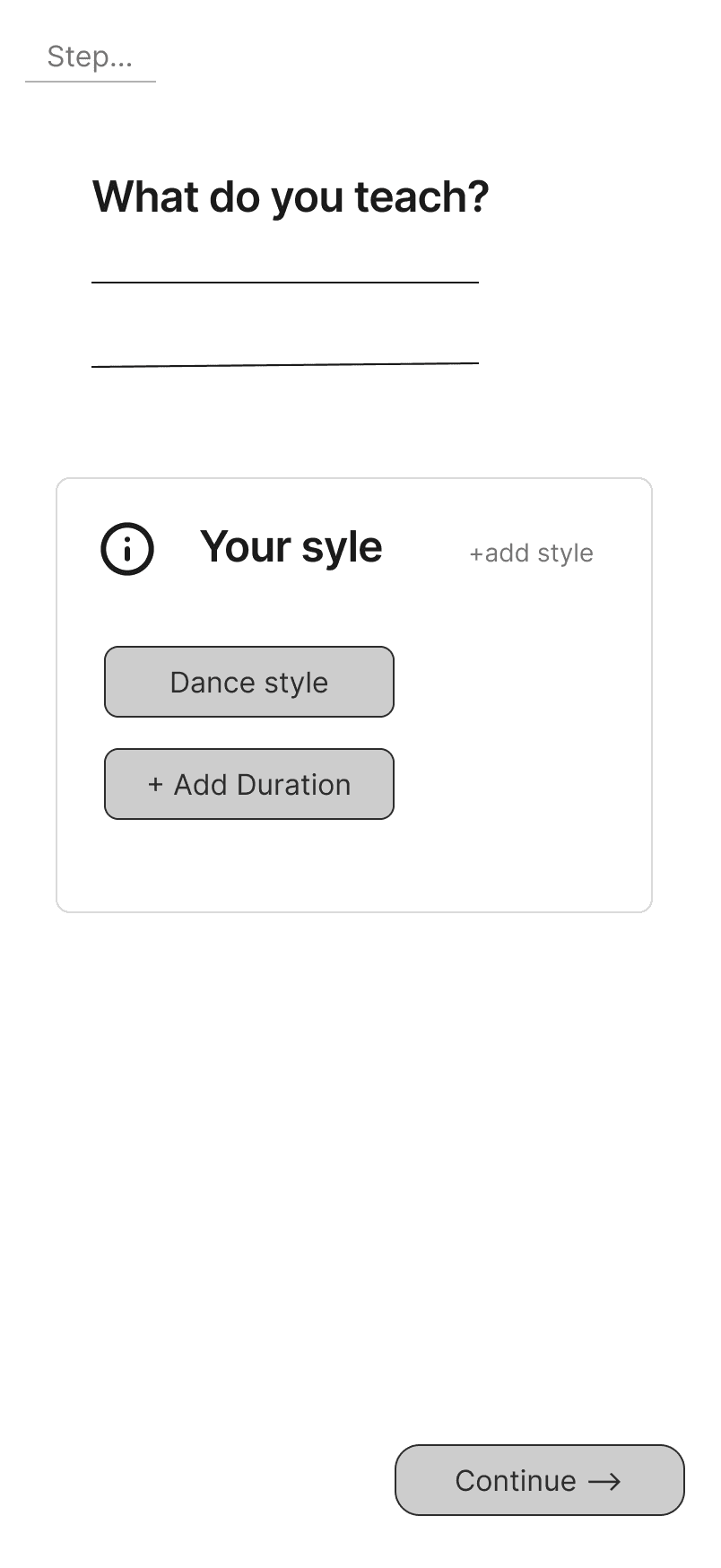
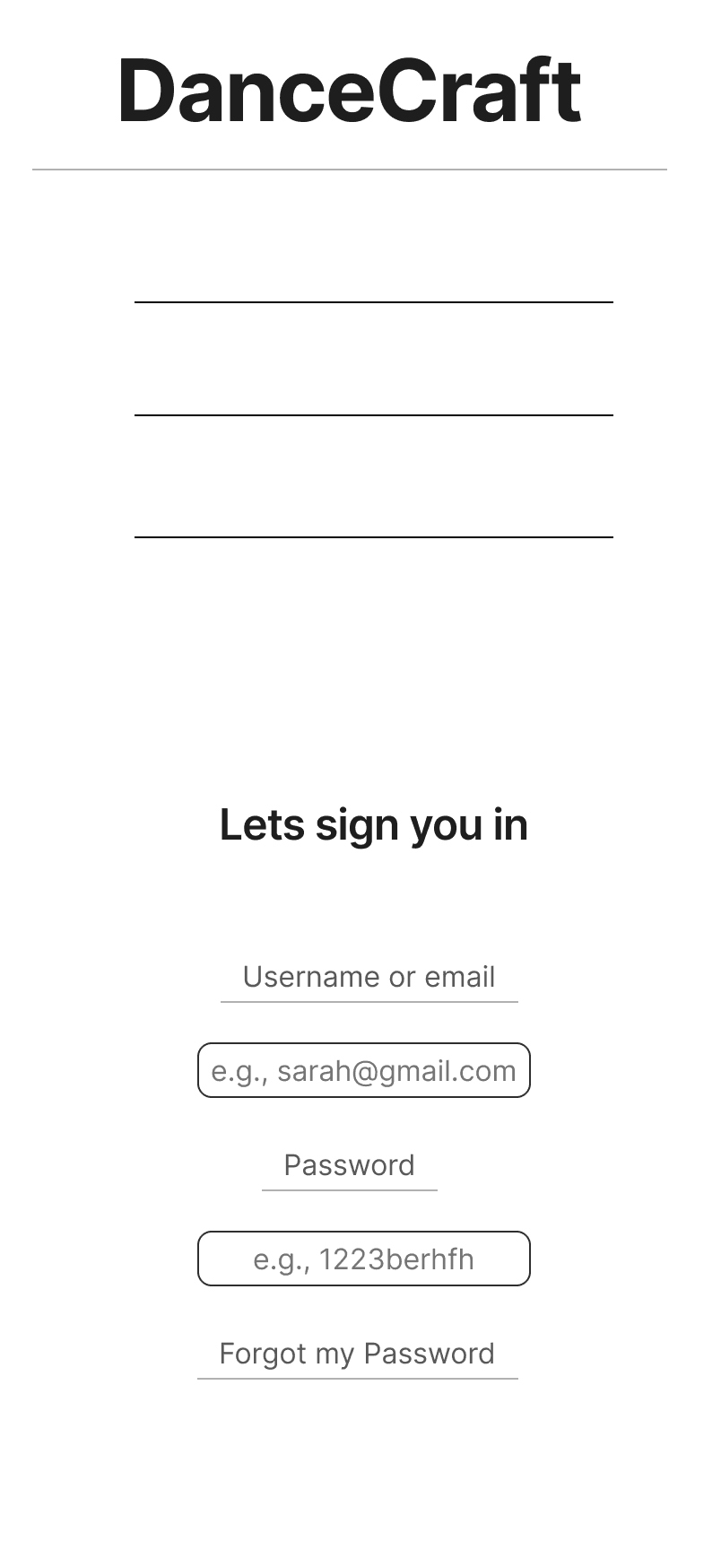
I translated the research findings into low-fidelity flows focused on instructor onboarding, availability, and private-lesson management.



Interactive Prototype
MVP usability testing
This study evaluated the DanceCraft platform across the three core dimensions of usability: Effectiveness, Efficiency, and Satisfaction.
10 participants each attempted 8 critical tasks, from creating an account to completing a lesson booking.
Effectiveness was strong: participants completed 96.3% of tasks (77 of 80), well above the 78% industry benchmark, and 7 of 10 completed every task without a critical error.
View TTC Scores and Task Completion
Efficiency results were also positive. The average time on task was 69.3 seconds against a 120-second target, 96.3% of timed tasks finished within that target, and the average Single Ease Question (SEQ) score was 6.46 out of 7.
View SEQ Scores
Satisfaction was excellent, with an average System Usability Scale (SUS) score of 89.0 (grade A+), well above the industry average of 68. The one area that needs work is “Upload/View Lesson Videos.” It had the lowest SEQ average (5.6), two task failures, and the slowest completion times, because participants had trouble finding where videos are stored. We recommend making this entry point easier to find in the next design iteration.
View SUS Scores
Implementation and Beta testing
After the usability findings were incorporated, DanceCraft was submitted to the Apple App Store and Google Play and approved on both. The app is now in public beta, where real students and teachers are testing it in their day-to-day lessons. Their feedback is guiding final refinements ahead of the full launch and marketing campaign. DanceCraft is available to download on iPhone and Android today.
Beta TESTING — IN PROGRESS

Reflection & impact
This project reinforced the value of grounding product decisions in real user behavior rather than assumptions. Research with both instructors and students revealed that the strongest opportunity was not just scheduling, but reducing fragmented communication while increasing visibility and trust for independent instructors.
DanceCraft evolved into a focused two-sided experience that helps instructors manage discovery, availability, bookings, payments, and profiles while giving students clearer information and an easier path to book private lessons. The final application directly reflects the highest-priority pain points identified through research and usability work.
Figma Prototype Interaction Video
Beta TESTING — INPROGRESS
Next project
